
The Set-Up: Poetry in the Ring
Posted by Emily Roach on 19th Mar 2026
In the foreground of James Ormsbee Chapin's 1928 painting, a Black boxer sits alone. His gloves rest on his knees, his gaze is fixed and blank, staring into the unseen ring before him. Behind him, his white manager leans against the ropes, gesturing languidly towards the spectators, who lurk in the shadows. This potent image seized the imagination of the poet Joseph Moncure March and became the seed for his 1928 narrative poem, The Set-Up.
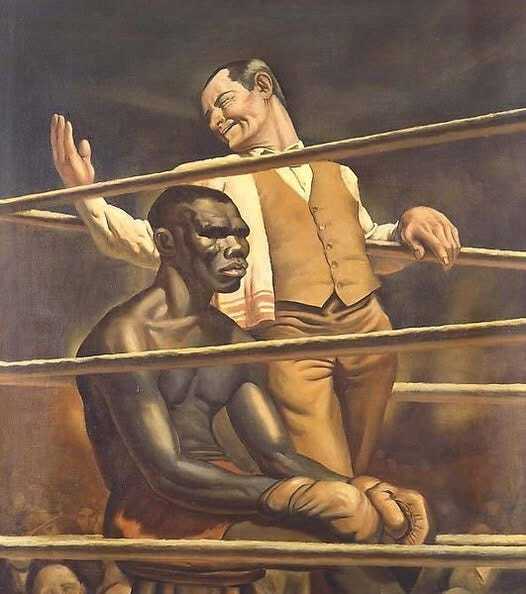
James Ormsbee Chapin's 1928 painting that inspired Joseph Moncure March's narrative poem
Conceived in New York to the rhythmic thump and clank of a machine shop, and finished on a shabby kitchen table in Rhode Island, The Set-Up is a tightly syncopated, atmospheric plunge into the world of prize-fighting in early 20th-century America. March paints a vivid and exhilarating portrait of this brutal arena, populated by greedy, scheming fight managers and the boxers they control, dupe, and misuse. Corruption lurks beneath the surface of every bout, compromising the morality of all involved. The story, set in prohibition New York, pivots on the inextricable link between boxing and organised crime, and on the prevailing racial politics of the era. Readers should be aware that in the immigrant-rich melting pot of 1920s New York, identity was inescapably bound by ethnicity.
The book's protagonist, Pansy Jones, is an ageing African-American boxer, a veteran used as fodder to advance the career of a young Italian-American hopeful. Against the viciousness of his sport and the casual inhumanity of his associates, Pansy stands firm, refusing to blindly accept his ill treatment. March described The Set-Up as the "story of a Negro fighter who had already been defeated by race prejudice but didn't know how to stop fighting." This sense of inescapable defeat gives the book its morally and stylistically claustrophobic feel. March's style possesses a distinct mnemonic tenacity - a rhythmic quality perhaps influenced by his relationship with Robert Frost - yet it is also capable of conveying drama and action with intense immediacy. His keen ear for the rhythms of everyday speech injects a strong sense of realism into the dialogue, even as the narrative hurtles forward.
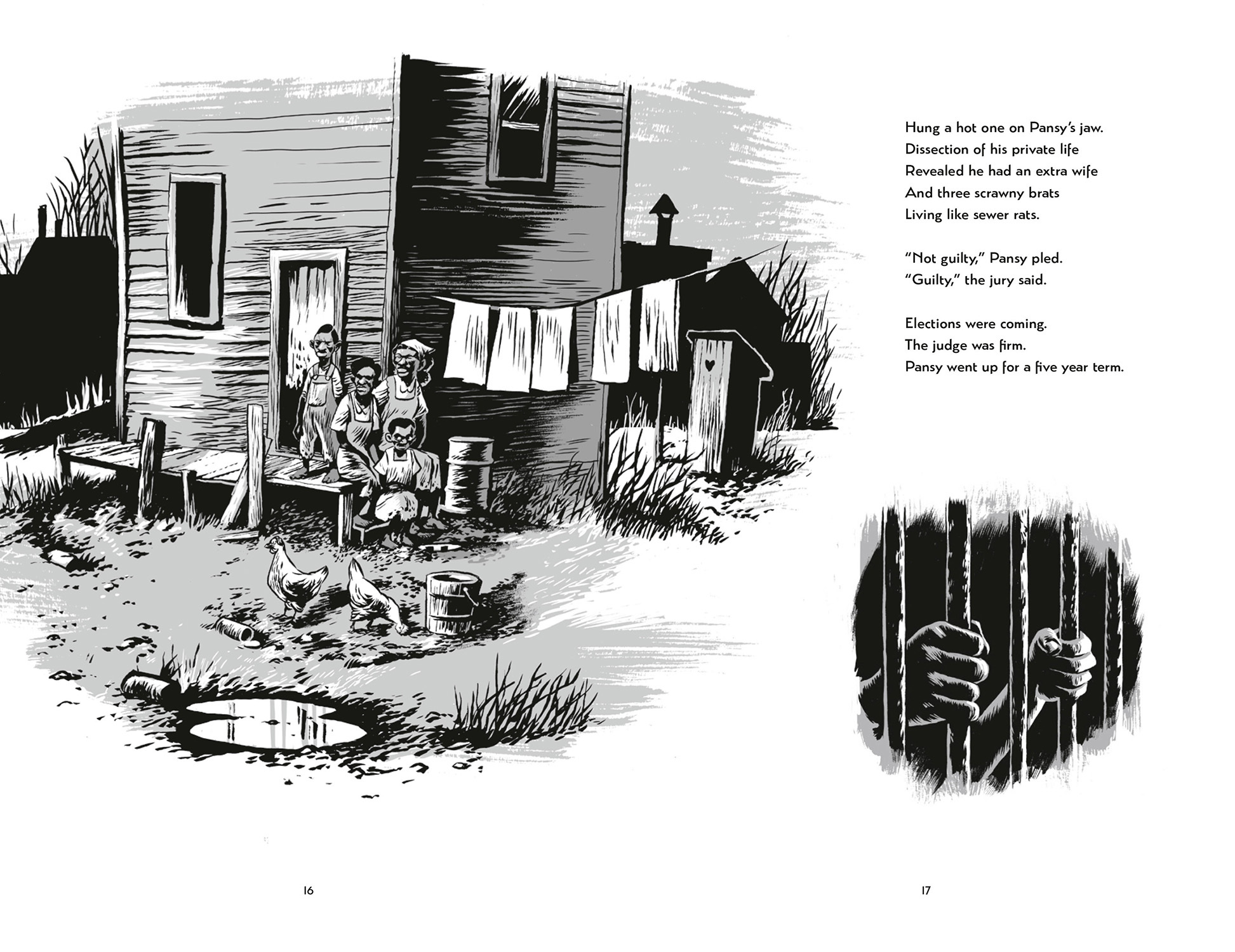
Illustrated spread by Erik Kriek from the 2022 Korero Press edition of The Set-Up
March was born into a prominent American family in 1899 and raised on Manhattan's Upper West Side, whose citizens, he noted, "had an intense and scientific preoccupation in the art of bouncing their knuckles off somebody's jaw." From an early age he "took it for granted that being an expert with fists was important", yet his privilege ensured such violence remained on the periphery of his own life. He explored the poverty of New York's slums vicariously, through Stephen Crane's Maggie: A Girl of the Streets, and would later write that his preference "had always been for the disreputable." But while he felt an affinity with this world, he was sufficiently removed from its reality to view it with a degree of idealism. This nascent idealism first emerged at Amherst College, where he battled with sour-faced professors over the value of poetry and co-published a satirical newsletter derisive of the college itself.
Enlisting in the US Army as a private in 1918—despite his uncle being a senior general—March took volumes of Keats and Shelley with him to war. He downplayed his family connections, an act met with derision by his fellow soldiers. He later lamented that his family's stance against nepotism was met with hostility from men who were "realists, and had no patience with anyone who did not take advantage of his advantages." Though he experienced only "the small fragment of war" in France, it was enough to cause a marked disruption; upon his return, he was allowed to graduate honoris causa.
In 1926, March became the first managing editor of the fledgling New Yorker magazine. His tenure, however, was short-lived. He soon fell foul of the formidable editor-in-chief, Harold Ross, who had imposed a blanket ban on sexual content and perhaps foresaw March's racier literary intentions. That same year, March published the narrative poem for which he is best known, The Wild Party. Briefly banned in Boston for its risqué content, it became a succès de scandale, a "hard-boiled jazz-age tragedy" (in the words of Art Spiegelman) that William Burroughs credited with making him want to become a writer. Its distinctive style led critic Louis Untermeyer to admit he "hadn't the faintest idea whether it is good or bad poetry."
In The Set-Up, March's meticulous control of the reader's gaze seems to anticipate cinematic techniques; fast-paced images appear like composite shots, rendering scenes in vivid and violent flashes. In Herman's bar, our eyes are directed through photographic stills of the details until the whole scene breathes with life. A crowd outside an arena is not a mass, but a collection of individuals, revealed only when the light catches their shadowy extremities:
"Hats stuck out, dented, gashed. Wrinkles made black cracks across yellow, swaying backs…Mouths were holes: Eye sockets looked like deep, black pockets."
Such stark imagery, coupled with the text's even darker morality, forms a direct line to the film noir style. In 1947, March sold the film rights, and Robert Wise's 1949 adaptation for RKO became a noir classic. Yet March, whose offer of help was rejected, was left to witness the adaptation from his cinema seat. To his horror, he saw that the director had carefully whitewashed the story.
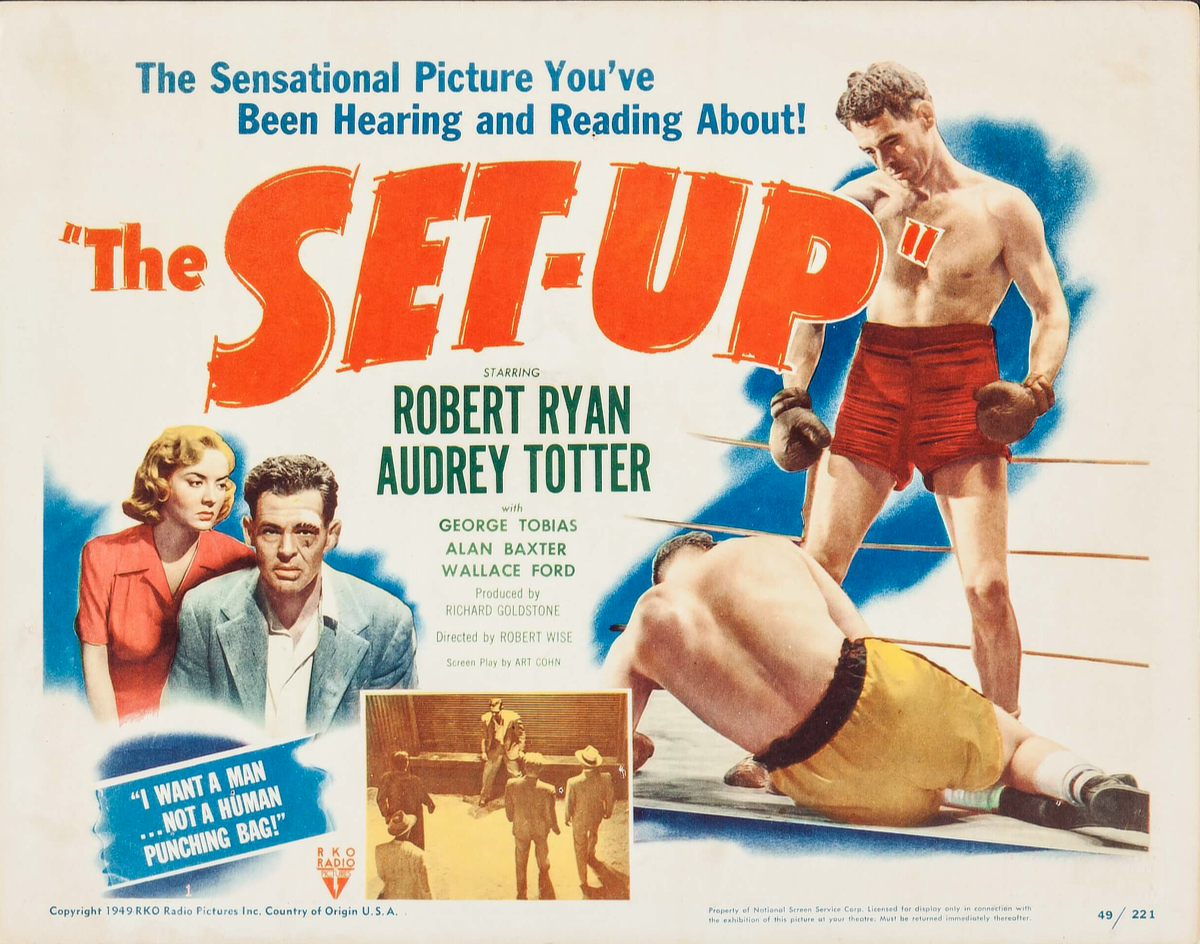
1949 lobby card for Robert Wise's film noir adaptation starring Robert Ryan and Audrey Totter
"I was really disgusted to find that the hero of the picture was no longer a Negro fighter: they had turned him into a white man!" he recalled. "The whole point of the narrative had been tossed out the window. Ah Hollywood...!"
March himself had worked as a screenwriter from 1929 to 1940, a career he later dismissed as "eleven disheartening years in the salt-mines." This experience, however, informed the cinematic essence of his poems. And in The Set-Up, this cinematic quality merged with something new: an element of documentary.
March insisted The Set-Up "was never intended to be a social protest," yet he felt it possessed a harsh documentary quality, like a "photograph of a lynching." But despite his bid to "reflect the melting-pot character of New York as it was in those days," his own prejudice taints the narrative, preventing it from achieving true documentation. His attack on racism is sincere, and his attempt to depict it is earnest, but he was too embedded in the very prejudice he sought to criticise to construct a successful polemic. This was a world he did not inhabit; he viewed it with cinematic reverence and a dash of voyeurism. His depiction is, while well intentioned, undoubtedly warped. This was the world of a man who would carefully sit on a new hat to give it "proper character," a world in which his former mother-in-law, upon discovering his mother was Viennese, exclaimed, "Ah – that explains it. I always felt there was something un-American about you."
March himself came to acknowledge this conflict. In 1968, a new edition of The Set-Up and The Wild Party was published under the title A Certain Wildness, featuring an introductory memoir by the author. In it, March had, as he put it, "denationalised all the characters." In the rewritten The Set-Up, aside from Pansy, all the characters were now “white”. But this pruning of the story's racial dimension made it wither. With its essential structure compromised, the characters could no longer stand. In censoring his own authorial prejudice, March had mirrored the very artistic decision taken by Robert Wise—the decision he had so vehemently loathed.
The Set-Up works best as it was originally written. Regardless of the criticism it remains an undeniably powerful and compelling read. March's voice is unlike any other, and this work has been unjustly neglected. It's a book that moves, that swings, that lives and breathes. It's a "hard-boiled tragedy" that will stick with you, not as a dry historical artifact, but as a thrilling, visceral experience.
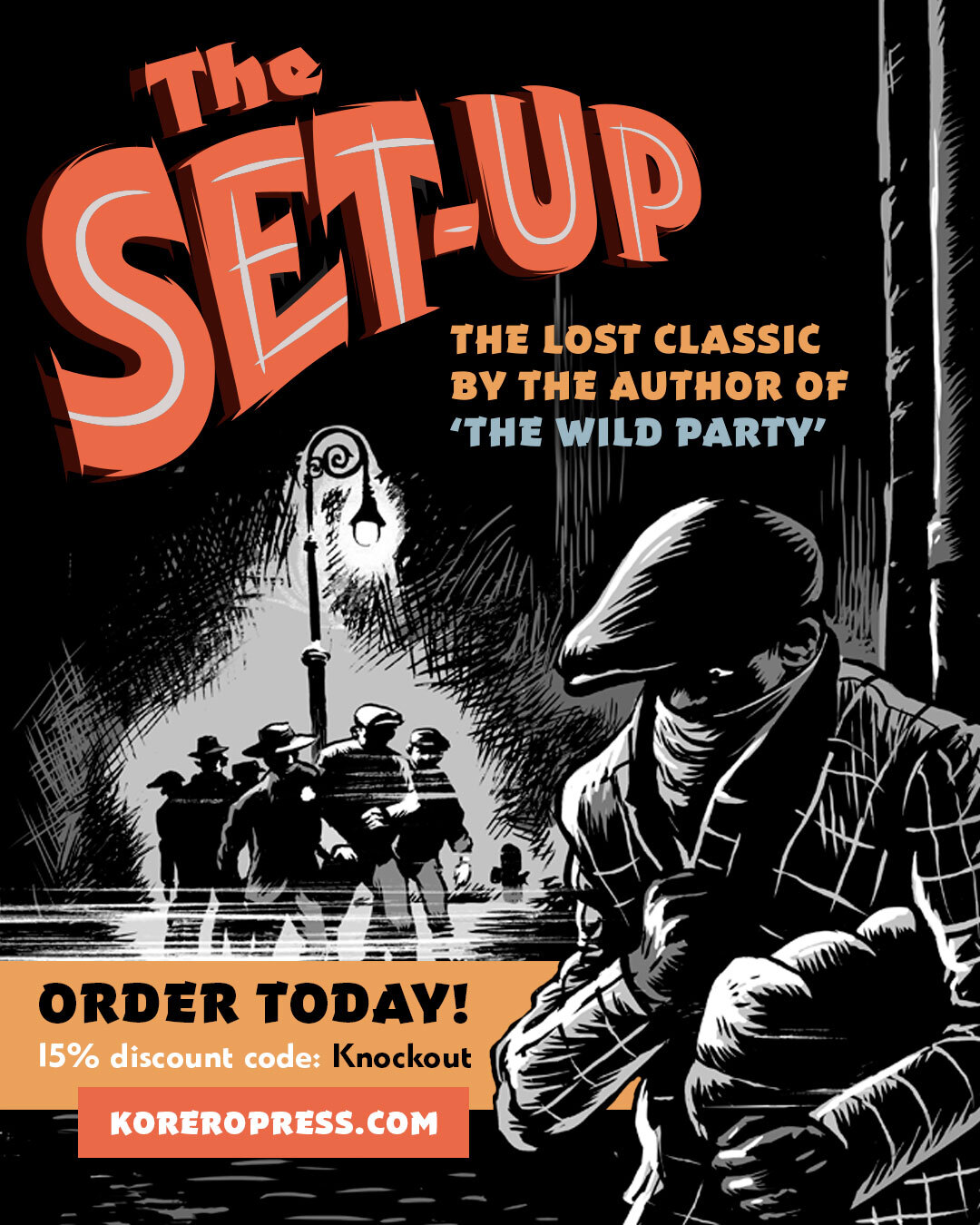
So, if you're looking for something different—a book that combines the raw energy of a pulp novel with the sonic beauty of poetry—pick up The Set-Up. It's a knockout.